
Computer-generated imagery (CGI) is defined as the use of 3D rendering software to produce photorealistic visualisations of interior spaces before they are built or refurbished. Understanding how CGI communicates interior design concepts matters because it has replaced guesswork with spatial precision, giving designers, architects, and property developers a shared visual language that clients can actually read. IKEA now produces over 75% of its catalogue imagery through CGI. That figure alone signals how thoroughly the industry has shifted from photography to rendered visuals as the default communication standard. Visualtrick works within this same discipline, producing photorealistic interior renders for designers, architects, and developers across the UK and worldwide.
How does CGI communicate interior design concepts?
CGI communicates interior design concepts by translating spatial data, material specifications, and lighting conditions into a single photorealistic image that any stakeholder can interpret without technical training. The industry term for this process is architectural visualisation, sometimes shortened to archviz. Both terms describe the same discipline: converting design intent into a rendered image that stands in for the finished space.

The core mechanism is accuracy. A well-produced CGI render shows the correct ceiling height, the actual colour of a fabric under a specific light source, and the true scale of furniture relative to the room. Mood boards and hand sketches cannot do this. They suggest atmosphere, but they do not confirm spatial relationships. CGI confirms them.
Modern rendering software has reached a quality level where finished images are indistinguishable from photography. That quality removes the interpretive gap between what a designer intends and what a client imagines. When both parties look at the same render, they are looking at the same room.
What technologies underpin CGI in interior design visualisation?
Photorealistic rendering is the product of several converging technologies working together. Understanding the components helps designers and developers brief CGI studios more effectively and set realistic expectations for output quality.
The primary techniques include:
- Ray tracing and path tracing: These algorithms simulate how light bounces between surfaces, producing accurate shadows, reflections, and ambient occlusion. The result is a render that behaves like a photograph taken inside a real room.
- Physically based rendering (PBR): PBR assigns real-world material properties to surfaces. A linen fabric absorbs light differently from polished concrete, and PBR captures that distinction with measurable accuracy.
- High dynamic range (HDR) lighting: HDR environments replicate natural and artificial light sources at their true intensity, so a north-facing bedroom reads differently from a south-facing living room in the same render set.
- AI-assisted workflows: AI tools now accelerate texture generation, upscaling, and scene composition, reducing production time without compromising output quality.
- Parametric modelling: Designers can adjust dimensions, materials, and layouts within the 3D model, producing multiple variants from a single scene file.
88% of digital marketers now use AI or CGI tools daily. That adoption rate reflects how mature and accessible these technologies have become across property development and design sectors.
Pro Tip: When briefing a CGI studio, supply material specifications in PBR format where possible. Providing hex codes, fabric weave references, or manufacturer finish codes gives the 3D artist measurable data rather than subjective descriptions, and the render will be more accurate as a result.
What are the practical advantages of CGI over traditional design communication?
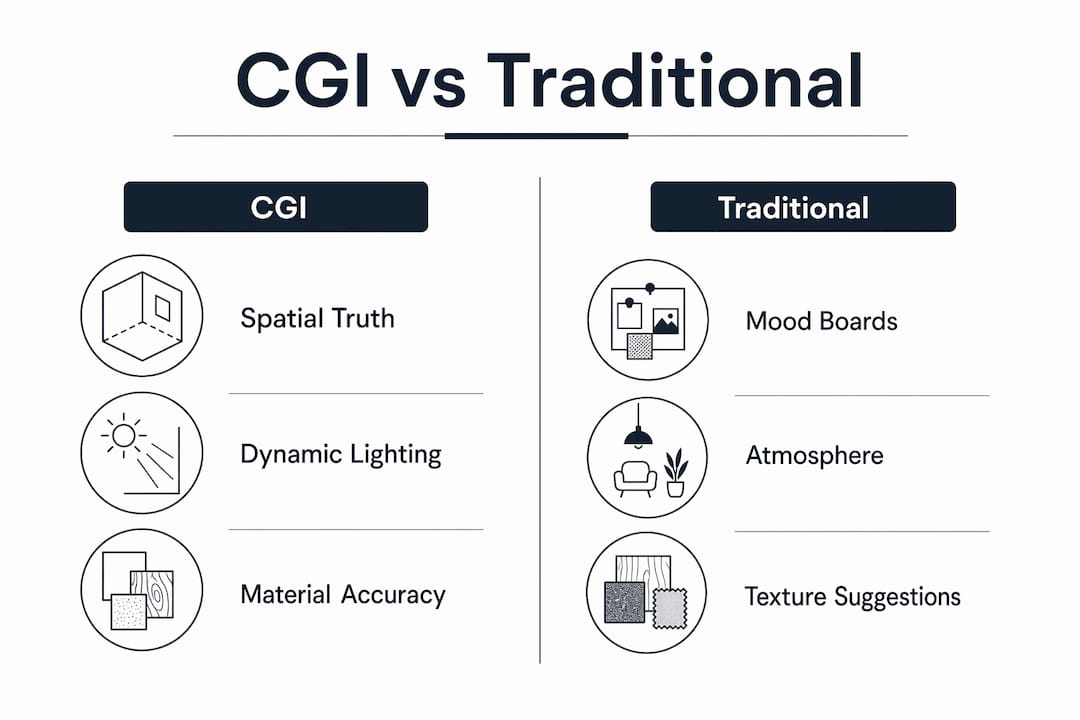
CGI delivers what mood boards cannot: spatial truth. A mood board communicates atmosphere and material sensibility, but it does not confirm whether a sofa fits the room or whether a pendant light clears the dining table. CGI answers both questions before a single item is ordered.
3D rendering shows accurate scale, light, and layout while mood boards communicate atmosphere and sensory material qualities. The two tools are complementary, not competing. Most experienced designers use both: CGI to confirm spatial decisions, mood boards to establish the emotional register of a scheme.
The practical gains extend well beyond client presentations. CGI enables earlier concept communication with suppliers and retail partners, shortening development cycles and reducing costs. A developer can share a render with a furniture supplier before the building is complete, locking in lead times and pricing months earlier than a traditional workflow allows.
For marketing and sales, the advantage is equally clear. Renders produced during the design phase can go directly into brochures, property listings, and investor decks. There is no need to wait for a show home to be dressed and photographed. The sales process starts earlier, and the imagery is consistent across every channel.
Pro Tip: Produce a suite of renders at different times of day from the same scene file. A living room render in morning light and evening light gives your client a fuller picture of how the space will feel across a day, and it costs a fraction of what two separate photography sessions would.
How does CGI maintain emotional resonance in interior design?
CGI’s greatest technical strength is also its most common creative weakness. A render that is technically perfect but emotionally cold will not sell a space or win a client’s confidence. This is a particular risk in care sector marketing, where the role of CGI in care facility design demands warmth and authenticity rather than clinical precision.
Generic, clinical CGI renders in care and senior living marketing fail emotionally. Visuals that highlight lifestyle, diverse demographics, and lived-in details generate better emotional engagement than overly polished, empty-room renders. The lesson applies equally to residential and hospitality interiors: a render without people, personal objects, or signs of life reads as a showroom, not a home.
Strategies for preserving emotional warmth in CGI include:
- Adding lifestyle elements: Books on a coffee table, a half-drunk cup of tea, a throw draped over a chair. These details signal habitation and make a render feel inhabited rather than staged.
- Including people: Figures placed naturally within a scene give scale and context. In care environment layouts, showing residents engaged in activities communicates community rather than capacity.
- Pairing CGI with physical samples: Sending a fabric swatch or a paint chip alongside a render gives clients a tactile reference point. The CGI confirms the spatial arrangement; the sample confirms the material feel.
- Varying the camera angle: A render shot from seated eye level reads differently from one shot at standing height. Choosing the angle that matches how a person would actually experience the room adds authenticity.
Authentic CGI visuals generate over 50% more engagement than traditional stock photography in healthcare marketing. That gap reflects the difference between a generic image and one that has been composed to reflect a specific community and lifestyle.
How should designers and developers implement CGI effectively?
Effective CGI implementation starts with a clear brief. Designers and developers who treat CGI as an afterthought, commissioning renders once the design is already finalised, miss the medium’s greatest advantage: the ability to test and iterate before anything is built.
The most productive workflow integrates CGI at the concept stage. A rough 3D model produced early in the design process allows a designer to test spatial arrangements, identify proportion problems, and present options to a client before committing to a scheme. Revisions at this stage cost a fraction of what they cost after specification is complete.
- Define the audience for each render. A render for a planning application needs to show context and scale. A render for a sales brochure needs to show lifestyle and aspiration. A render for a client approval meeting needs to show material accuracy. Each purpose requires a different composition and level of finish.
- Collaborate with a specialist CGI studio early. Studios like Visualtrick bring technical knowledge of lighting, materials, and camera composition that most design practices do not hold in-house. Engaging them at the concept stage rather than the delivery stage produces better results and fewer revisions.
- Build a library of scene variants. A single 3D model can produce renders for multiple audiences. Commission a core scene file and then specify variants: different material options, different lighting conditions, different furniture configurations. The marginal cost of each variant is low once the base model exists.
- Avoid over-rendering. A render that tries to show everything often communicates nothing clearly. Choose a focal point for each image and compose the scene around it.
- Use CGI alongside other communication tools. Physical samples, floor plans, and mood boards each carry information that CGI does not. The strongest client presentations combine all four.
AI-enhanced CGI visuals allow customisation to match specific audience interests, increasing trust and connection. For property developers targeting distinct buyer profiles, this means producing render variants that reflect the lifestyle of each demographic rather than a single generic interior.
Pro Tip: Ask your CGI studio to deliver the scene file alongside the finished renders. Owning the file means you can commission additional variants later without rebuilding the model from scratch, which saves significant time and budget on future projects.
Key takeaways
CGI communicates interior design concepts most effectively when it combines spatial accuracy with emotional authenticity, integrated from the concept stage rather than applied at the end of the design process.
| Point | Details |
|---|---|
| CGI delivers spatial truth | Renders confirm scale, light, and layout in ways mood boards and sketches cannot. |
| Emotional warmth requires deliberate effort | Lifestyle details, figures, and physical samples prevent renders from feeling clinical or empty. |
| Early integration saves cost | Commissioning CGI at the concept stage allows low-cost iteration before specification is locked. |
| Audience defines composition | Planning visuals, sales brochures, and client approvals each require a different render approach. |
| Scene files are reusable assets | Owning the 3D model file allows cost-effective variant production for future campaigns. |
Why CGI still needs a designer’s eye
I have worked with CGI long enough to know that the technology does not replace design judgement. It amplifies it. A poorly conceived interior looks worse in a photorealistic render than it does in a sketch, because the render removes all ambiguity. Every proportion problem, every material clash, every lighting mistake is visible at full resolution.
The designers and developers I see getting the most from CGI are the ones who treat it as a thinking tool, not a presentation tool. They use early renders to challenge their own assumptions, not just to impress clients. That shift in mindset changes everything about how the workflow runs.
The integration of virtual reality and AI into CGI workflows is accelerating. Clients will soon expect to walk through a rendered space in real time, not just view a static image. That raises the stakes for quality and consistency across every asset in a project. The studios that will lead this shift are the ones already producing renders with the spatial accuracy and emotional depth that immersive formats demand.
CGI is not a replacement for design intuition. It is the clearest possible expression of it. The designers who understand that distinction will use it to build stronger client relationships, win more approvals, and deliver better projects. The ones who treat it as a commodity will produce renders that look like every other render on the market.
— Paride
Visualtrick’s CGI services for interior design professionals
Visualtrick produces photorealistic interior CGI for designers, architects, and property developers who need visuals that communicate with precision and warmth. Every render is built from accurate spatial data and finished to a standard that works across planning applications, marketing campaigns, and client presentations.
For care sector projects, Visualtrick’s care home CGI services deliver lifestyle-focused renders that reflect the warmth and community of a real environment rather than the sterile appearance of an empty room. For architects and developers working across residential and commercial schemes, Visualtrick’s architectural visualisation services cover every stage from concept to completion. The team works with clients across the UK and internationally, delivering visuals that are accurate, planning-ready, and built to perform.
FAQ
What is CGI in interior design?
CGI in interior design is the use of 3D rendering software to produce photorealistic images of interior spaces before they are built. The industry term is architectural visualisation, and it covers everything from concept renders to marketing-ready imagery.
How does CGI improve client communication in design projects?
CGI shows clients an accurate representation of scale, materials, and lighting in a finished space, removing the interpretive gap that mood boards and sketches leave open. Clients can make informed decisions earlier, which reduces costly revisions during construction.
Can CGI replace mood boards in interior design?
CGI and mood boards serve different purposes and work best together. CGI delivers spatial accuracy while mood boards communicate tactile and sensory qualities that a render cannot fully replicate.
How is CGI used in care home and care facility design?
CGI communicates care environment layouts by showing how spaces will function and feel for residents and families. Lifestyle-focused renders that include people and personal details perform significantly better in care sector marketing than clinical, empty-room imagery.
How do I brief a CGI studio for an interior design project?
Provide accurate floor plans, material specifications in measurable formats such as manufacturer codes or PBR data, and a clear brief for each render’s intended audience. Engaging the studio at the concept stage rather than the delivery stage produces better results and fewer revisions.
