
The most effective types of visualisation for property marketing are exterior CGI renders, interior renders, 3D floor plans, virtual tours, animated walkthroughs, aerial views, and interactive digital twins. Each serves a distinct purpose in the sales cycle, from generating initial interest to closing off-plan deals with buyers who have never set foot on site.
Here is a quick map of the core formats and where they fit:
- Exterior renderings — hero shots, street-level perspectives, aerial views, and seasonal variants that establish the property’s identity and context
- Interior renderings — photorealistic room-by-room visuals that help buyers imagine finishes, lighting, and atmosphere
- 3D floor plans — elevated, textured layouts that convey spatial flow far more clearly than a flat blueprint
- Virtual tours and 360° walkthroughs — immersive, navigable environments for remote and off-plan buyers
- Animated fly-throughs — cinematic sequences used at property expos, investor events, and launch campaigns
- Aerial and drone-integrated views — CGI or real drone footage that places a development in its neighbourhood context
- Interactive digital twins — real-time environments where buyers explore specific units, validate views, and check daylight conditions before purchase
Visualtrick delivers all of these formats for UK developers, estate agents, architects, and property marketers, producing planning-ready and marketing-grade visuals from a single studio.
Table of Contents
- Why visualisation gives property marketing a measurable edge
- The main types of 3D visualisation for UK real estate marketing
- Emerging trends reshaping property visualisation in the UK
- How to choose and apply visualisation effectively
- Visualtrick: high-end CGI for UK property marketing
- Key takeaways
Why visualisation gives property marketing a measurable edge
Buyers make faster, more confident decisions when they can see a finished space rather than imagine it. That is the commercial logic behind every pound spent on property visualisation, and it holds whether you are selling a two-bed flat off-plan or pitching a 500-unit masterplan to investors.
The practical benefits break down into three areas:
- Buyer confidence — photorealistic renders and virtual tours replace abstract floor plans with spatial certainty, reducing the hesitation that delays off-plan sales
- Marketing reach — immersive content performs significantly better across digital channels; visual content consistently drives higher engagement than text or static photography alone
- Decision speed — interactive tools that let buyers validate sightlines, daylight, and layout from a specific unit replace abstract imagination with certainty, shortening the sales cycle
There is also a competitive dimension. At property expos and launch events, a development presented through a high-quality animated walkthrough or a touchscreen digital twin commands attention in a way that a printed brochure simply cannot. The role of visualisation in property expo marketing has shifted from a nice-to-have to a baseline expectation among serious buyers.
The strategic case in one sentence: buyers who can explore a property visually before visiting are better qualified, more committed, and less likely to withdraw after reservation.
Estate agents benefit too. CGI for new-build listings generates enquiries earlier in the sales cycle, before the show home is ready, and supports premium pricing by anchoring buyer perception of quality from the first touchpoint. Visualtrick’s CGI services for estate agents are built specifically around this use case.
The main types of 3D visualisation for UK real estate marketing
Exterior renderings
Exterior renders typically include hero shots, street-level perspectives, aerial views, and seasonal variations. Each targets something different: facade materials and architectural detail, neighbourhood context, scale from above, and the emotional pull of a development in summer light versus a crisp winter morning. For new-build marketing, the hero exterior render is usually the first visual a buyer sees, so the quality of that single image carries disproportionate weight.

Blending drone photography with CGI is particularly effective for grounding a development in its real surroundings rather than floating it in a generic landscape. That combination builds buyer trust in a way that pure CGI alone rarely achieves.
Interior renderings
Interior renders cover living rooms, kitchens, bedrooms, and bathrooms with photorealistic accuracy. Material selections, lighting design, and furniture styling do the heavy lifting here: they differentiate unit tiers, communicate finish quality, and help buyers project themselves into the space. For developers selling multiple unit types, a targeted set of interior renders for each tier is more persuasive than a single generic image.
Stylised or conceptual renders have their place too, particularly for early-stage design approvals or lifestyle-led campaigns where mood matters more than material precision.
3D floor plans
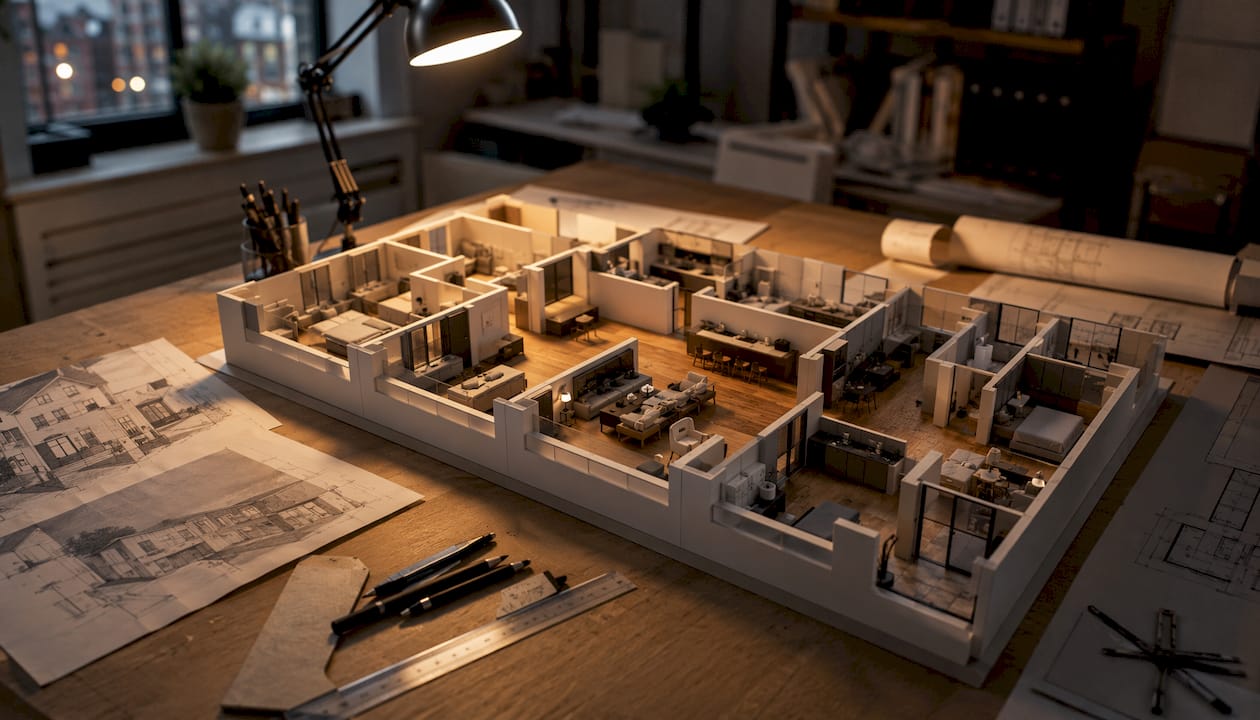
A 3D floor plan gives buyers the bird’s-eye spatial clarity of a traditional blueprint, but with depth, textured surfaces, and scaled furniture. It is the format that answers the question buyers always ask: “How does this actually feel to move through?” Paired with an interior render, a 3D floor plan closes the gap between layout logic and lived experience.
Virtual tours and 360° walkthroughs
Virtual tours provide immersive 360° experiences that allow buyers to explore a property remotely, navigating from room to room and looking in any direction. For out-of-town or overseas buyers, this format is often the deciding factor in whether they book a physical visit. Linked panoramic views or fully navigable digital environments build the kind of confidence that static imagery cannot replicate.
Visualtrick’s work in off-plan sales visualisation demonstrates how virtual tours reduce buyer hesitation at the reservation stage, particularly when the physical site is still under construction.
Animated fly-throughs and cinematic sequences
Animations add time and movement to what renders can only freeze. A well-produced fly-through shows a development waking up in morning light, reveals the approach from the street, and moves through communal spaces in a way that feels like a film trailer rather than a technical document. These sequences are the format of choice for launch events, investor presentations, and property expo marketing, where you have 60–90 seconds to make an impression.
Aerial and drone-integrated views
Aerial CGI places a development in its wider context: proximity to green space, transport links, and the character of the surrounding neighbourhood. When combined with real drone footage, the result grounds the render in verifiable geography. This is especially valuable for large-scale schemes where location is a core part of the value proposition.
Interactive digital twins
Digital twins are the most technically demanding format and the one that is changing buyer expectations fastest. A high-quality digital twin lets a buyer navigate a development in real time, select a specific unit, check the view from that floor level, and see how daylight moves through the space at different times of day. For off-plan sales, this replaces abstract imagination with something close to certainty.
Modern buyers increasingly expect this kind of consultative, interactive experience rather than a static presentation. Switching from brochures to interactive digital twins tends to shorten sales cycles, particularly for high-value or complex developments where buyer hesitation is the main obstacle to reservation.
Finish configurators and unit selection tools
Configurators allow buyers to swap materials, finishes, and fixtures in real time, seeing the impact of their choices on the rendered space. This is most common in premium residential schemes where personalisation is part of the offer. The commercial benefit is twofold: buyers feel invested in the unit before they sign, and developers capture preference data that informs procurement decisions.
| Visualisation type | Best application | Key strength |
|---|---|---|
| Exterior rendering | Launch marketing, planning applications | Establishes architectural identity |
| Interior rendering | Pre-selling, brochures, listings | Communicates finish quality and atmosphere |
| 3D floor plan | All buyer-facing materials | Spatial clarity without full render cost |
| Virtual tour (360°) | Remote and off-plan buyers | Immersive exploration from any device |
| Animated fly-through | Expos, investor events, social media | Cinematic impact in under two minutes |
| Aerial / drone-integrated | Large schemes, location-led marketing | Places development in real context |
| Interactive digital twin | Sales suites, high-value off-plan | Real-time unit validation, shorter sales cycle |
| Finish configurator | Premium residential, bespoke schemes | Buyer personalisation and commitment |
Emerging trends reshaping property visualisation in the UK
VR and AR are moving from novelty to standard
VR and AR technologies are increasingly used to offer walkthroughs of unbuilt properties and to overlay digital models onto physical construction sites. A buyer visiting a cleared plot can hold up a tablet and see the finished building standing in front of them at full scale. That is not a gimmick; it is a tool that converts scepticism into confidence at a critical moment in the sales process.
VR headset experiences remain more common at high-end sales suites and investor presentations than in everyday residential sales, but the cost of production is falling. Expect wider adoption across mid-market new-build schemes over the next two to three years.
AI-driven 3D modelling is accelerating production
AI is reducing the time and cost required to produce high-quality renders and interactive environments. Automated material generation, lighting simulation, and scene population are compressing production timelines without sacrificing visual quality. For developers who need to move quickly from planning approval to marketing launch, this matters.
The practical implication for UK property marketers is that the gap between “we have planning” and “we have marketing-ready visuals” is narrowing. Studios that integrate AI-assisted workflows into their CGI production can turn around hero renders in days rather than weeks.
Real-time interactive environments and data integration
The most significant shift in property visualisation is the integration of live inventory data into interactive visual platforms. A buyer exploring a digital twin can see in real time which units are available, reserved, or sold, and filter by floor level, view orientation, or unit type. This merges the accuracy of a CRM with the immersion of a 3D environment.
For UK developers managing large schemes with multiple phases, this kind of platform reduces the administrative burden on sales teams and gives buyers a self-service tool that qualifies their interest before they speak to anyone.
How to choose and apply visualisation effectively
Match the format to the project stage
The right visualisation type depends on where a development sits in its lifecycle. At concept stage, stylised renders and 3D floor plans are sufficient for stakeholder alignment and early-stage planning applications. At pre-launch, hero exterior renders and interior renders for each unit tier are the priority. At sales launch, virtual tours, interactive digital twins, and animated fly-throughs take over.
Combining multiple visualisation types tailored to project stage, buyer profile, and marketing channel consistently produces better results than relying on a single format. A hero exterior render attracts initial interest; a virtual tour converts that interest into a qualified enquiry; a finish configurator converts the enquiry into a reservation.
Tier your visuals by buyer persona
Not every buyer needs the same depth of visual information. First-time buyers respond strongly to interior renders that show a finished, furnished space. Investors prioritise aerial views, location context, and yield data integrated into an interactive platform. Downsizers want to understand spatial flow and natural light. A tiered visual strategy that addresses each persona directly is more efficient than producing a single set of generic assets.
Pro Tip: For large residential schemes, commission a core set of hero renders first and use them to test buyer response before investing in a full digital twin. The feedback from early enquiries often shapes which unit types and finishes deserve the most detailed treatment.
Understand the limitations of each format
Static renders are powerful but fixed. Once produced, they cannot adapt to design changes without additional cost. Virtual tours require more production time and budget than still images. Digital twins are the most expensive format to produce and maintain, and their value is highest on schemes with 50 or more units where the complexity justifies the investment. Animated fly-throughs are not searchable or interactive, so they work best as supporting content rather than a primary sales tool.
Cost considerations vary significantly by format and studio. A single photorealistic exterior render sits at a different price point to a fully interactive digital twin with live inventory integration. The key is matching investment to the commercial return: a £5m penthouse scheme warrants a different visual budget than a ten-unit conversion.
Visualtrick’s approach to UK developments: high-end CGI that is accurate enough for planning applications and compelling enough for sales campaigns, delivered from a single studio without the overhead of a large agency. Their architectural visualisation services span the full range from planning-ready stills to immersive 3D walkthroughs, with work across residential, healthcare, and commercial sectors.
Visualtrick: high-end CGI for UK property marketing
Developers and estate agents working on new-build schemes in the UK face a specific challenge: they need visuals that satisfy planning committees, impress investors, and convert buyers, often from the same set of assets. Most agencies specialise in one end of that spectrum. Visualtrick covers all of it.
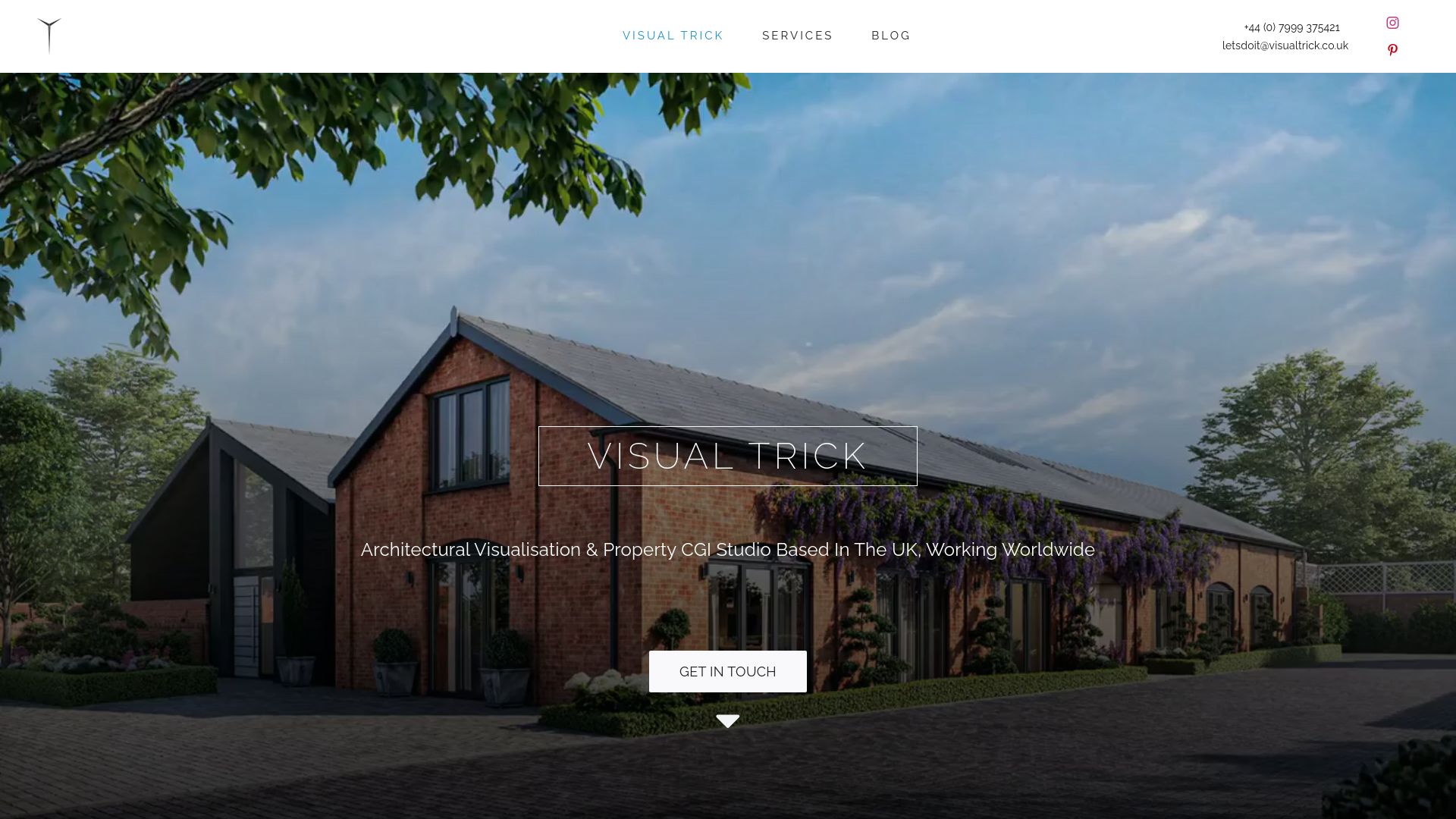
Visualtrick produces photorealistic exterior and interior renders, 3D floor plans, animated walkthroughs, and planning-grade CGI for developers, architects, estate agents, and property marketers across the UK. The studio works on residential schemes, care homes, retirement developments, and commercial projects, with a track record of delivering visuals that perform at every stage from planning to sales close. Whether you need a single hero render for a planning application or a full suite of marketing assets for a major launch, Visualtrick’s 3D rendering services are built around the specific demands of the UK market.
For architects and interior designers, dedicated CGI services are available at CGI for architects and CGI for interior designers. Get in touch with Visualtrick directly to discuss your project and receive a tailored quote.
Key takeaways
The most effective property marketing programmes combine multiple visualisation types, matched to project stage and buyer persona, rather than relying on a single format.
| Point | Details |
|---|---|
| Match format to stage | Use stylised renders for planning, hero CGI for launch, and interactive tools for sales conversion. |
| Tiered buyer strategy | Different buyers need different visuals: investors want aerial context, end-users want interior renders and virtual tours. |
| Digital twins for complex schemes | Interactive digital twins shorten sales cycles on large off-plan developments by replacing imagination with real-time certainty. |
| AI is compressing timelines | AI-assisted CGI production is reducing the gap between planning approval and marketing-ready visuals for UK developers. |
| Visualtrick for UK projects | Visualtrick delivers the full range of property visualisation formats, from planning-grade stills to immersive walkthroughs, for UK clients. |
