
Virtually staged images are allowed in UK listings, provided each altered photo carries a clear label, the original unstaged image is kept on file, and no edit changes structural features such as walls, windows or room layout. That’s the position under the Digital Markets, Competition and Consumers Act 2024 and the Consumer Protection from Unfair Trading Regulations. Agents who follow this pattern, and use a professional workflow, generally stay well inside the rules.
TL;DR:
- Virtually staged images in the UK must be clearly labeled, with the original photo kept on file and no structural edits to the property shown.
- Cosmetic staging is low risk when labeled properly, but structural changes or reused images can be misleading and subject to regulatory action.
- Labels should be visible on the image itself, with disclosures placed near the photo gallery and original photos retained for evidence.
- A comprehensive compliance workflow includes on-image labels, written disclosures, recording client consent, and verifying thumbnail size visibility.
- Disclaimers alone are ineffective; proper adherence to labeling, original photo preservation, and clear disclosures are essential to avoid legal challenges.
Table of Contents
- What UK laws govern virtual staging disclosure?
- When does a staged image become misleading?
- What should the image-level compliance checklist include?
- What wording can agents copy into listings and images?
- How should staged photos appear on portals and other channels?
- What happens if a staged image is challenged as misleading?
- How does Visualtrick keep virtual staging compliant?
- Why disclaimers alone won’t save you
- Get compliant virtual staging done properly from the start
- Where to check the rules yourself
- Sources
What UK laws govern virtual staging disclosure?
Three legal frameworks matter here, and they overlap deliberately rather than by accident.
The Digital Markets, Competition and Consumers Act 2024 replaced and strengthened the old unfair commercial practices regime. It treats misleading property marketing as an unfair commercial practice, and persistent or serious breaches carry criminal exposure, not just a slapped wrist from a regulator. This is the headline change agents need to register for 2026: enforcement has teeth.
Sitting underneath that, the Consumer Protection from Unfair Trading Regulations set the day-to-day test for whether a listing photo or description misleads a buyer. The Advertising Standards Authority enforces this across all marketing, including portal listings, social posts, and print brochures, not just paid adverts.
Propertymark’s own guidance is blunt: images must not be misleading, inaccurate photos should be pulled rather than tolerated, and a small disclaimer somewhere on the page won’t cure a genuinely misleading image if the Propertymark guidance is anything to go by.
Redress schemes add a final layer of accountability:
- Members of The Property Ombudsman or the Property Redress Scheme can face complaints and awards if a buyer feels misled by staged imagery.
- Estate agents have a statutory duty to avoid misdescription under the Estate Agents Act, separate from the newer consumer protection rules.
- Trading Standards can investigate any complaint referred by a consumer or a competitor agent.
Taken together, this is not a grey area you can shrug off with small print.
When does a staged image become misleading?
Regulators apply two tests: misleading action (something false is stated or shown) and misleading omission (something material is left out that would change a buyer’s decision). Both apply to virtual staging.
A few practical distinctions help agents judge risk before publishing:
- Cosmetic staging — adding furniture, rugs, artwork or soft furnishings to an empty room — is generally low risk when labelled, because it doesn’t misrepresent the property itself.
- Structural staging — inserting a window that doesn’t exist, removing a supporting wall, or altering a floorplan — is high risk and can constitute misleading action regardless of any label.
- Reused imagery — dropping a staged photo of one refurbished room into the listing for a different property — is a straightforward misdescription, not a staging question at all.
Regulators judge listings against the “average consumer” test: would a reasonably observant buyer, viewing the image at thumbnail size on a phone, be misled about what they’d actually get? Becca Farrelly’s analysis of estate agent advertising rules makes the point that this obligation runs across every channel, including what an agent says out loud during a viewing.
Pro Tip: Test every staged image at the size it will actually appear on a portal thumbnail, not full screen. A label that’s legible at 1200 pixels can vanish completely at 300, which is exactly the size most buyers scroll past on their phones.
What should the image-level compliance checklist include?
Build this into your workflow once, and it becomes automatic rather than a source of anxiety on every new instruction.
- Apply a visible label (“Virtually Staged” or similar) directly on every altered image, using a font and contrast strong enough to survive resizing to thumbnail dimensions.
- Add a written disclosure line in the property particulars, positioned near the photo gallery rather than buried in a footer.
- Keep the original, unstaged photo on file, named clearly (e.g. “LivingRoom_Original.jpg” vs “LivingRoom_Staged.jpg”).
- Brief negotiators on a short verbal script so nobody tells a buyer at viewing that staged items are included in the sale.
- Log written client consent for staging before commissioning any images.
| Action | Why it matters |
|---|---|
| Visible on-image label | Survives thumbnail compression; satisfies the “average consumer” test |
| Preserved originals | Evidence if a listing is ever challenged |
| Written particulars disclosure | Backs up the image label with material information |
| Recorded client consent | Reduces agent liability if a dispute arises |
What wording can agents copy into listings and images?
Wording doesn’t need to be clever. It needs to be visible and unambiguous.
Watermark captions, placed top left or top right at reduced opacity but with enough contrast to remain legible at thumbnail size:
- “Virtually Staged”
- “CGI Staged Image, Not Actual Furnishings”
- “Digitally Furnished for Illustration”
Listing copy templates, dropped near the photo gallery in the particulars:
- “Some images in this listing have been virtually staged to illustrate potential furniture layout. Furnishings shown are not included in the sale.”
- “This property is presented with digitally added furnishings for illustrative purposes only. Please contact [agent] for unstaged photography.”
For viewings, a one-line script works: “Just to flag, some of the online photos were digitally staged to show how the space could work. What you’ll see today is the property as it stands.” Adjust the wording if specific fixtures, curtains or appliances genuinely are included in the sale, since that changes the disclosure from generic to fact-specific.
How should staged photos appear on portals and other channels?
Where a portal allows it, upload the original unstaged photo first in the sequence, followed by the staged version, so buyers see the real room before the illustration. Use any portal-native “virtually staged” flag or metadata field if one exists rather than relying solely on a watermark.
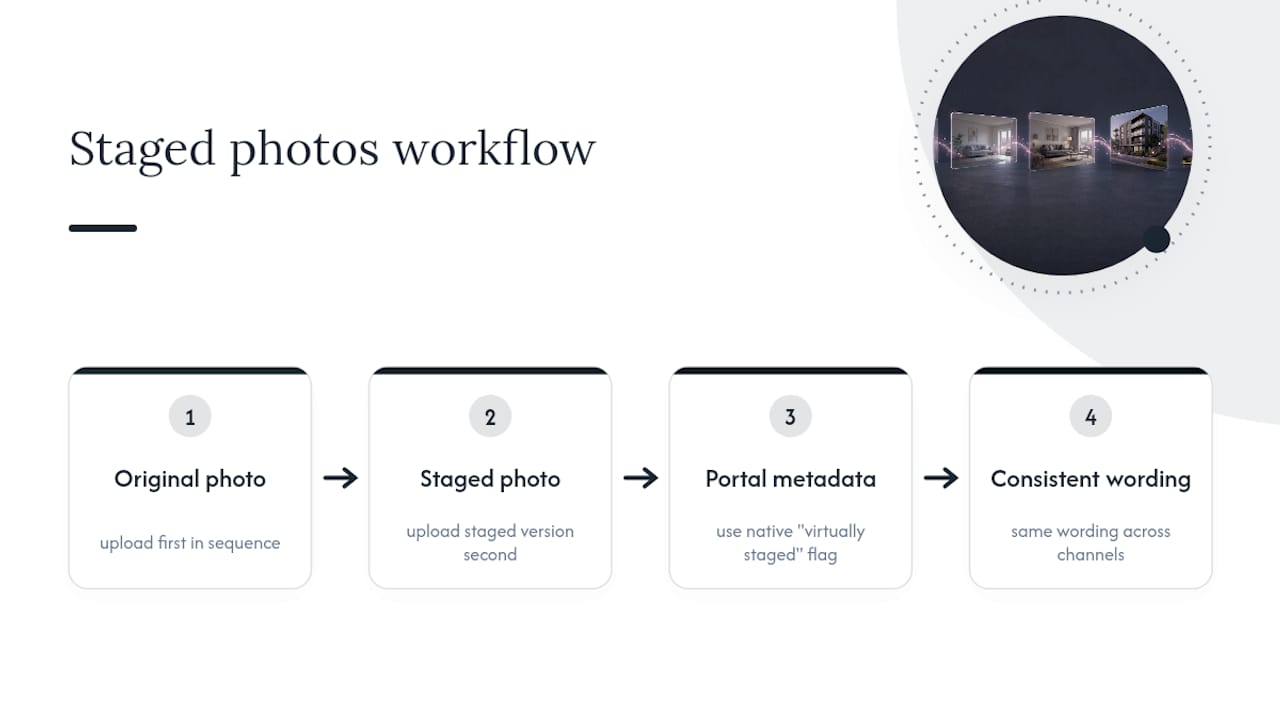
Where no such flag exists, the visible on-image label and particulars disclosure carry the full weight, so don’t skip either. Industry checklists consistently recommend originals-first ordering precisely because portals vary in what metadata support they offer.
For social media and print, where space is tight, keep the on-image label and add a fuller disclosure in the caption or a linked landing page. Coordinate wording across website, portal, social and printed particulars, since regulators look at the whole marketing picture rather than one channel in isolation, a point echoed in Catchouse’s guidance for agents on digital listing practice.
What happens if a staged image is challenged as misleading?
A complaint can reach Trading Standards, the ASA, or a redress scheme such as TPO or PRS, and any of the three can investigate independently. Outcomes range from a formal warning through to compensation awards, and in serious or repeated cases, criminal liability under the CPRs or DMCC Act.
If a challenge lands on your desk:
- Remove or correct the disputed image immediately rather than leaving it live while you investigate.
- Notify the client and preserve every version of the file, staged and original.
- Check your consent records and image labelling against what was actually published.
- Respond to the regulator or scheme with your documentation rather than a general denial.
Good recordkeeping, material-information documentation among it, is the single strongest mitigation an agent can produce.
How does Visualtrick keep virtual staging compliant?
Visualtrick provides CGI and virtual staging services for UK estate agents and property marketers, built around exactly the workflow this article describes. Every project preserves the original photography, delivers clearly labelled staged versions, and can supply disclosure wording matched to the property.
That structure removes the manual burden of tracking file versions and drafting captions on every instruction, which is where most compliance slips happen in busy agencies. None of this replaces legal advice on a specific listing dispute, but it does mean the evidential trail, labelling and originals, already exists before a query ever arrives.
Why disclaimers alone won’t save you
Most agents assume a general disclaimer buried in the terms and conditions offers cover. It doesn’t, not under the current regime, and Propertymark’s own guidance says so directly: a disclaimer is unlikely to cure a genuinely misleading image. The trend across regulators and industry bodies is towards item-level, image-by-image transparency rather than blanket small print, and that shift is the part most agents haven’t caught up with yet.
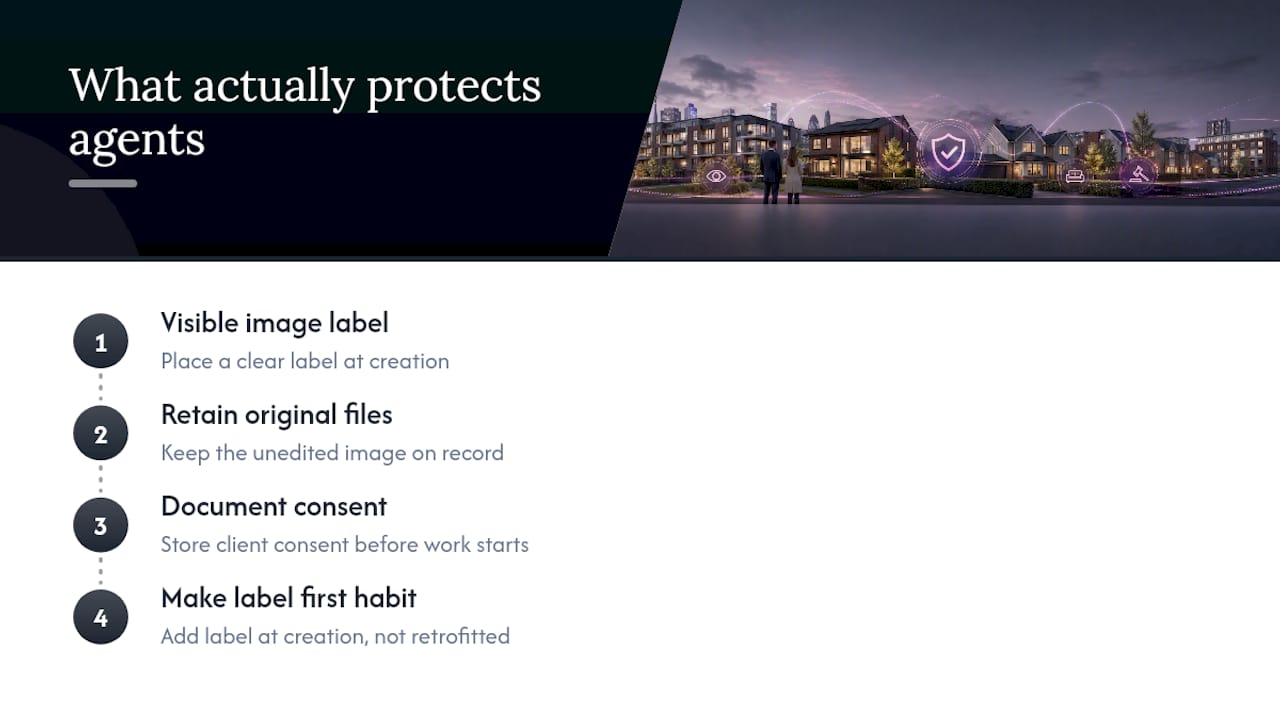
The conventional advice, “just add a disclaimer and you’re covered”, was already weak advice before the DMCC Act tightened the criminal exposure for serious or repeated breaches. What actually protects an agent is boring and procedural: a visible label on the image itself, an original file kept on record, and consent documented before the work starts. None of that is glamorous, but it’s the difference between a challenge that closes in a day and one that drags on for months.
If there’s one priority to act on first, it’s the label at the point the image is created, not retrofitted after a complaint arrives. Everything else, the particulars wording, the portal ordering, the verbal script, is easier to get right once that habit is in place.
— Paride
Get compliant virtual staging done properly from the start
Virtual staging services can be built around the same three pillars this article has covered: preserved originals, clear on-image labelling, and disclosure copy ready to drop into your particulars. That’s the practical advantage over knocking together staged images in-house or hoping a freelancer remembers to keep a backup file.

Every staged image comes with its unstaged counterpart on record, so if a listing is ever queried, the evidence trail is already there rather than something you have to reconstruct under pressure. Beyond staging, Visualtrick also supports agents with wider CGI for estate agents work, from exterior visuals to full marketing suites. If you have an instruction that needs staging done right first time, consider contacting providers through the virtual staging service page and ask about a compliance-ready sample for your next listing.
Where to check the rules yourself
- Unfair commercial practices guidance from gov.uk on the DMCC Act 2024
- Propertymark’s guidance on images and the Consumer Protection regulations
- TPI’s material information guidance for property listings
- ListingAI’s compliance guide covering practical UK disclosure wording
Sources
- Gov
- Propertymark guidance on images and the Consumer Protection regulations
- Material information in property listings — TPI
- Virtual staging rules in United Kingdom | ListingAI compliance guide
